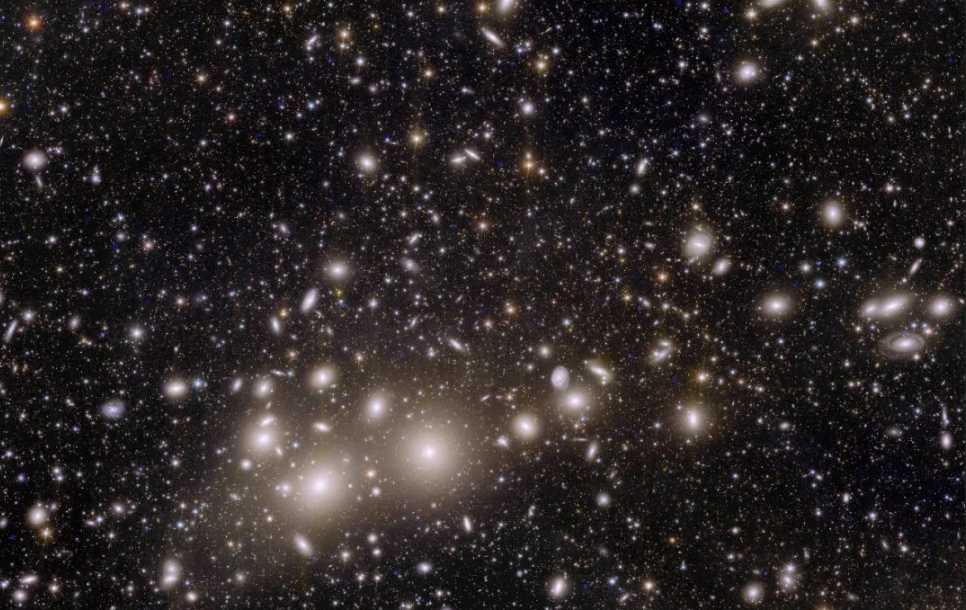
Abell 426 dominates its corner of the constellation Perseus, with its central elliptical galaxy, NGC 1275, acting as a gravitational anchor. The cluster’s 1,000 member galaxies are bound by gravity, forming a structure spanning millions of light-years. But the true marvel lies in its background: deep-sky images reveal 100,000 faint galaxies beyond, their light traveling billions of years to reach Earth. These distant objects serve as cosmic signposts, helping researchers map the invisible web of dark matter.
Scientists study Abell 426 by analyzing how dark matter—comprising ~85% of the universe’s mass—warps space-time. This phenomenon, called gravitational lensing, distorts the light from background galaxies, creating telltale arcs and smudges in images. By mapping these distortions, researchers can:
- Reconstruct the distribution of dark matter within the cluster.
- Test theories about dark matter’s gravitational effects on cosmic structure.
- Validate models of universe evolution, where dark matter acts as the "scaffolding" for galaxy formation.
Computer simulations of Abell 426 show that dark matter’s gravitational pull not only holds the cluster together but also influences the motion of its galaxies and the distribution of hot, X-ray-emitting gas between them. This invisible component’s role is so crucial that without it, the cluster would fly apart.
It in Abell 426’s field emit light from when the universe was just 3.8 billion years old (current age: ~13.8 billion years). Studying their lensed images allows astronomers to:
- Compare dark matter distributions in the early universe versus today.
- Investigate how galaxy clusters like Abell 426 grew over cosmic time.
- Search for anomalies in gravitational lensing that could hint at new physics beyond standard dark matter models.
As telescopes like the James Webb Space Telescope peer deeper into such clusters, Abell 426 remains a pivotal case study—proving that even in the vastness of space, the key to understanding the universe’s invisible scaffolding lies in the careful analysis of galaxy shapes and their cosmic dance.