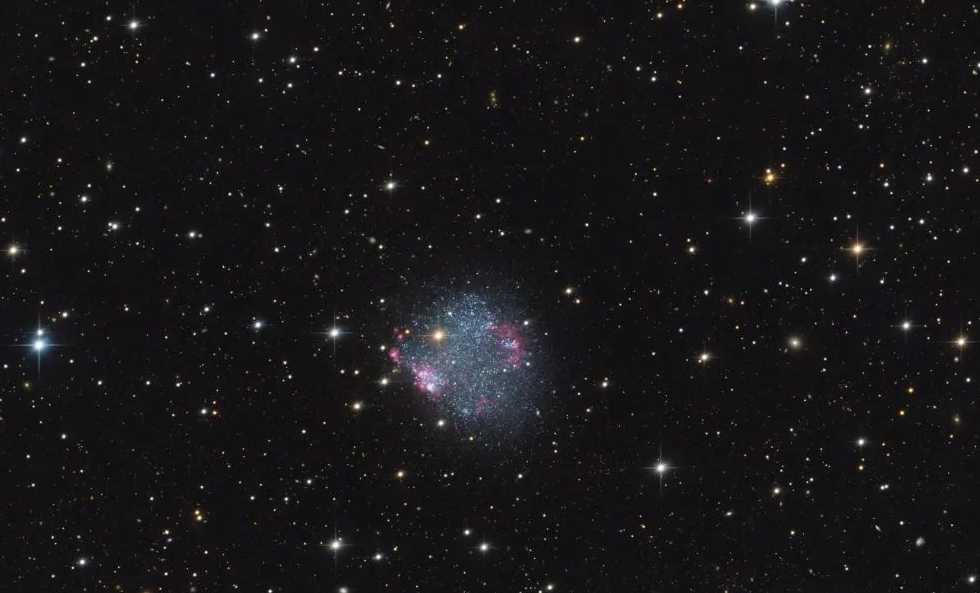
Sextans A defies the spiral galaxy’s grand design with the chaotic beauty of the universe’s underdogs. Its star-forming regions glow in pink hydrogen nebulae, punctuated by blue clusters of newborn stars—each "droplet" of stellar birth containing millions of suns. The galaxy’s irregular shape, sculpted by gravitational interactions with neighboring systems, belies its role as a prolific star factory despite its diminutive size.
"Astronomers once overlooked dwarf galaxies like Sextans A, but they’re crucial for understanding star formation in low-mass environments," says Dr. Maya Johnson of the Lowell Observatory. The galaxy’s gas-rich composition—largely hydrogen and helium with little heavy elements—makes it a time capsule for studying primordial star birth.
This telescope image reveals Sextans A veiled by golden star trails from foreground Milky Way stars, creating a cosmic illusion of lace draped over the distant galaxy. The contrast between the nearby stars’ sharp spikes and Sextans A’s diffuse glow highlights the vastness of intergalactic space:
- Foreground Stars: These belong to our galaxy, lying just thousands of light-years away, their light passing through the same line of sight.
- Sextans A’s Clusters: Each amber-hued clump is a star-forming region tens to hundreds of light-years across, where massive stars ionize surrounding gas.
At the Local Group’s edge, Sextans A survives in relative isolation, a rare example of a galaxy evolving without frequent major mergers. Its stars, born in bursts over billions of years, carry chemical signatures that trace the galaxy’s history—a cosmic story written in the glow of its ambery stellar nurseries, far from the bustling cores of larger galactic neighbors.