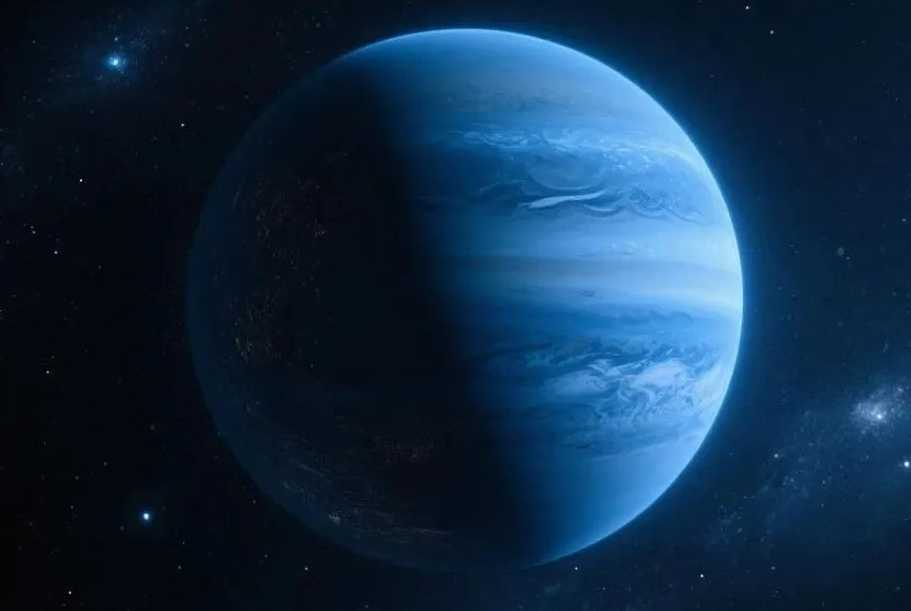
Situated at an average distance of about 4.5 billion kilometers from the Sun, Neptune's location places it in the coldest reaches of our solar system. With an average surface temperature of -214°C (-353°F), it endures a frozen existence. Its gravitational pull, stemming from a mass 17 times that of Earth, is just sufficient to maintain its predominantly gaseous state. Composed mainly of hydrogen, helium, and methane, Neptune's atmosphere is a cauldron of activity. Here, the fastest winds in the solar system rage, reaching speeds of up to 2,100 km/h. These powerful winds fuel colossal storms that can persist for decades, like the Great Dark Spot, a storm system the size of Earth observed by the Voyager 2 spacecraft in 1989.
What makes Neptune even more remarkable is its discovery story. It was the first planet to be found through mathematical prediction rather than direct observation. In the 19th century, astronomers noticed irregularities in Uranus' orbit, leading to the hypothesis that another planet's gravity was causing these perturbations. Scientists John Couch Adams and Urbain Le Verrier independently calculated the position of this unknown planet, and in 1846, Johann Gottfried Galle confirmed Neptune's existence by observing it in the predicted location. This scientific feat showcases the power of mathematics in exploring the cosmos. With 14 known moons and a faint ring system, Neptune continues to intrigue researchers, offering a glimpse into the far - flung and mysterious regions of our solar system.