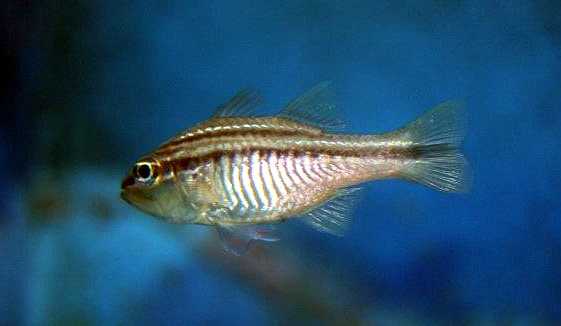
Growing up to 10 centimeters in length, the four-lined cardinalfish features a large head, large eyes adapted for low-light vision, and a forked caudal fin that aids in agile maneuvering among coral branches. Juveniles often exhibit brighter colors and more pronounced lines, which may fade slightly in adults but remain a defining trait. By day, it seeks shelter in the protective crevices of coral reefs, seagrass beds, or under rocky overhangs, emerging at night to forage for small invertebrates, zooplankton, and tiny crustaceans. This species is often found in small groups or pairs, relying on its cryptic coloration to avoid daytime predators such as larger fish and octopuses.
Distributed from the Red Sea and East Africa to the waters of Japan, Australia, and the Society Islands, Apogon quadrilineatus plays a vital role in reef ecosystems as both a predator of microfauna and a prey species for larger carnivores. While not targeted for commercial fishing due to its small size, it is occasionally collected for the aquarium trade, valued for its colorful appearance and peaceful demeanor in community tanks. However, like many reef-dependent species, it faces threats from coral reef degradation, ocean acidification, and habitat destruction caused by coastal development. Conservation efforts focused on preserving coral reef habitats and promoting sustainable aquarium trade practices are crucial to ensuring the survival of this charming cardinalfish. As a symbol of the intricate biodiversity within tropical reef systems, Apogon quadrilineatus highlights the need for global action to protect these fragile ecosystems.